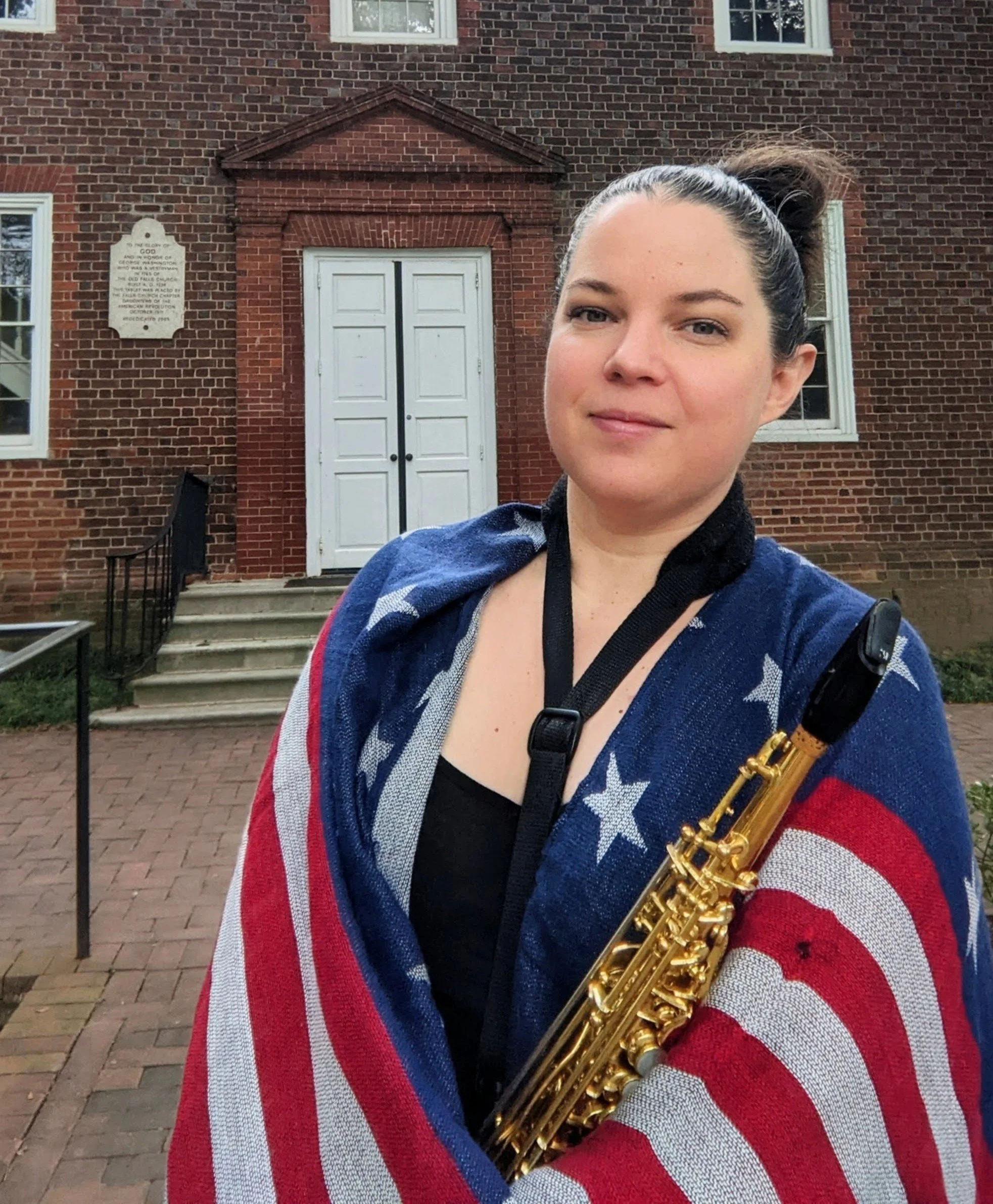
Classical saxophonist
maureen walsh plays
The Music of America
Meet the musicians:
Pianist Nikola Paskalov:
Praised for his “brilliance in expression . . .illuminated by gentle intensity” (Fränkische Landeszeitung), pianist, Nikola Paskalov, has actively performed internationally, having given solo and chamber music concerts throughout Europe and USA. Nikola Paskalov, a graduate of the High School under the Moscow Conservatory, Faculty of Music in Skopje, and the European Mozart Academy in Poland, commenced his professional career at the age of sixteen, performing with orchestras and playing recitals. He pursued his studies under the guidance of esteemed professors and participated in international master classes.
Paskalov has performed on various concert stages in Europe, including symphonic orchestras, chamber ensembles, and solo recitals. He received an award from the Macedonian Association of Music Artists for his outstanding achievements. In recent years, he has performed regularly in the USA, including at the “Carnegie Hall”, with Bowen McCauley Dance company at the “Kennedy Center”, and La Paz, Bolivia, where he performed Rachmaninov’s Second Concerto with the Cochabamba Symphony Orchestra.
Nikola appears on recordings under different labels and recorded a solo project with recording of Chopin, Rachmaninov and Glassl streaming on all streaming platforms. At the same time he recorded Nikola Glassl’s piano concerto with the Symphony Orchestra of Croatian Radio under their label. After moving to Washington, DC, he performed as a concert pianist, collaborated with distinguished musicians, and encouraged young pianists. He also opened and successfully ran a private piano studio in McLean, Virginia.
Maureen’s Note: I have played two previous programs with Nikola, including French music and 80’s music (which we will play again in 2026.) He is a prolific teacher and always has something interesting to tell me about the composers we are working with, so I am also always learning a lot from him!
Cellist Emily Doveala (DC Metro Area):
Dr. Emily Doveala is a cellist and music educator who is passionate about creating meaningful musical experiences for both audiences and music students. Emily began playing the cello at age nine and later started her formal musical training at Mannes Prep, studying with Dorothy Lawson of the ETHEL Quartet. She went on to receive her Bachelor of Music at Ithaca College, studying with Elizabeth Simkin and Heidi Hoffman, and her Master’s Degree from Stony Brook University, studying with Colin Carr. In 2022, Emily completed her Doctor of Musical Arts degree at the University of Maryland, studying with Dr. Eric Kutz. Emily has taught at the Mclean School and was an adjunct faculty member at College of Southern Maryland.
Currently, Emily is an active freelance musician and cello teacher in the Washington, D.C. area. In addition to teaching private lessons, Emily teaches at the International School of Music. Emily is involved in several chamber music projects, performing around the DC Metro area at salon concerts, faculty recitals, social clubs, and more. As an orchestral musician, she has played with the Fairfax Symphony Orchestra, Amadeus Orchestra, PanAmerican Symphony Orchestra, Great Falls Philharmonic, American Festival Pops Orchestra, Alexandria Symphony, Annapolis Opera Company, Binghamton Philharmonic, Washington City Choir, and Baltimore Choral Arts Society. In a 2021 recital project on the music of jazz-classical composer Nikolai Kapustin, Emily performed with pianist Ria Yang for both the Metropolitan Museum of Art’s Balcony Bar at Home series and for a recital at the Baltimore venue An Die Musik LIVE. Emily also had the opportunity to join the spring 2019 tour of the cutting-edge group Cordis, playing five-string electric cello. She has had the privilege of performing in famous venues such as Carnegie Hall, The Kennedy Center, the Barnes at Wolf Trap, Symphony Space, Alice Tully Hall, the Mozarteum Great Hall in Salzburg, and National Sawdust in Brooklyn.
On the Program:
Duo ..................................................................................................... Aaron Copland
Aaron Copland was born on November 14, 1900, in Brooklyn, New York, to his parents Harris Morris Copland and Sarah Mittenthal Copland, both of whom were Jewish immigrants from Russia. He was the youngest of five children. His earliest musical training came from his older sister, Laurine, as she taught him how to play the piano. He began formal training in 1914 with Leopold Wolfsohn, and began studying counterpoint and composition with Rubin Goldmark 2 years later. Discouraged by the strict rules of 19th century music imposed on him by Goldmark, Copland took it upon himself to explore the music of the more innovative and modern composers of his day.
In June of 1921, his explorations led him to France, where he attended the Summer School of Music for American Students at Fontainebleau. While abroad, Copland began thinking about the American soundscape. “There is a French-sounding music, a German sound, why not American?” Copland returned to New York in 1924 with 2 goals in mind: to compose the best music he could, and to promote the cause of American music and to increase performance opportunities for composers. Throughout his decades-long career, he composed a wide range of music, from abstract concert music to collaborative works for radio, film, ballet, and opera. His works placed him in the center of the contemporary music scene as a leader, where his efforts and dedication helped to establish the American sound on a global scale and set new standards for composers to come.
Duo was commissioned by John Solum and fellow students and friends of flutist William Kincaid after his passing in 1967. The piece was originally composed for flute and piano, in honor of the flutist. It is around 14 minutes in length, and is composed of 3 movements: Flowing; Poetic, somewhat mournful; and Lively, with bounce. It premiered in Philadelphia on October 3rd, 1971. Copland described the piece as “lyrical and in a pastoral style,” saying that “lyricism seems to be built into the flute…the whole is a work of comparatively simple harmonic and melodic outline, direct in expression. Being aware that many of the flutists who were responsible for commissioning the piece would want to play it, I tried to make it grateful for the performer...it requires a good player.”
Maureen’s Note: William Kincaid’s students wrote a book from his collected writings called Kincaidiana, which became essential in my development of musicianship during college. So now I am grateful to him for two reasons!
“Aaron Copland, 1900-1990.” The Library of Congress, www.loc.gov/item/n79089419/aaron-copland-1900-1990.
Aaron Copland Foundation. “The Man Behind the Music.” Aaron Copland, 14 Oct. 2022, www.aaroncopland.com/about/the-man-behind-the-music.
Aaron Copland Foundation. “Duo For Flute and Piano.” Aaron Copland, 23 July 2019, www.aaroncopland.com/works/duo-for-flute-and-piano.
Summerland ................................................................... William Grant Still
William Grant Still was born on May 11, 1895 in Woodville, Mississippi, to parents who were teachers and musicians. William lost his father when he was only a few months old, and his mother moved them to Little Rock, Arkansas. His music education began at the high school where his mom taught, as he received private violin lessons, and later found inspiration from the Red Seal operatic recordings bought for him by his stepfather. He attended Wilberforce University to obtain a B.S. degree, but ended up spending his time there conducting the band, learning to play the various instruments involved and making his initial attempts to compose and to orchestrate. He eventually went on to study at the Oberlin Conservatory of Music, which was financed at first by a legacy from his father, and later by a scholarship established by the faculty just for him.
Still was a true pioneer in the music scene. He was the first Afro-American in the United States to have a symphony performed by a major symphony orchestra; The first to conduct a major symphony orchestra in the United States, when in 1936, he directed the Los Angeles Philharmonic Orchestra in his compositions at the Hollywood Bowl; The first Afro-American to conduct a major symphony orchestra in the Deep South in 1955, when he directed the New Orleans Philharmonic at Southern University; The first of his race to conduct a White radio orchestra in New York City; The first to have an opera produced by a major company in the United States, when in 1949, his Troubled Island was done at the City Center of Music and Drama in New York City; The first to have an opera televised over a national network. He had an innate ability to compose music capable of capturing the interest of the greatest conductors of the time: truly serious music, but with a definite American flavor. He is “The Dean of African-American Classical Composers.”
Summerland is the second of three movements of the Three Visions suite. The suite tells the story of the human soul's experience after death. Summerland is where the “good” souls go, and is often correlated with the Spiritualist idea of Heaven. The suite was originally written for chamber orchestra, and was composed for Still’s wife, Verna Arvey, who played for the premiere of the piece in Los Angeles in 1936. Summerland is about 5 minutes in length, making it the longest movement of the 11 minute suite. Still’s composition mixes elements of jazzy harmony and European impressionist styles to evoke a quiet, warm atmosphere with a relaxed and lyrical tone.
Orchestra, Atlanta Symphony. “William Grant Still | Atlanta Symphony Orchestra.” Atlanta Symphony Orchestra, www.aso.org/artists/detail/william-grant-still.
“Summerland (Orch. Morris).” Wind Repertory Project, www.windrep.org/Summerland_(orch._Morris).
Porgy and Bess Suite ..................................................... George Gershwin
George Gershwin was born in Brooklyn, New York, on September 26, 1898, and was the second son to his Russian immigrant parents. As a child, George showed no interest in anything studious, so it came as a delightful surprise to his family when they discovered he had been secretly learning to play the piano. In 1914, George dropped out of school to work as a Tin Pan Alley song plugger. Within three years, “When You Want ‘Em, You Can’t Get ‘Em; When You Have ‘Em, You Don’t Want ‘Em,” was published, though it created little interest. It was “Swanee”– turned into a smash hit by Al Jolson in 1919– that brought George into the limelight. His career ambition was to compose serious music… and the first low chuckle of the solo clarinet and its spine-tingling run up the scale in Rhapsody In Blue caught the attention of the public and opened the doors to a new era in American music. In 1924, George teamed up with his brother, Ira, and “The Gershwins” became the dominant Broadway songwriters, creating infectious rhythm numbers and poignant ballads, fashioning the words to fit the melodies with a “glove-like” fidelity. George was in the height of his career when he tragically collapsed and died of a brain tumour on July 11, 1937. He was only 39 years old.
The Porgy and Bess Suite or Catfish Row (as retitled by Ira Gershwin) was directly influenced by the music of the Gershwin musical, Porgy and Bess. In 1926, George read Porgy, DuBose Heyward’s novel of the South Carolina Gullah culture, and immediately recognized it as a perfect vehicle for a “folk opera” using blues and jazz idioms. Porgy and Bess was co-written with Heyward and Ira Gershwin. The musical was George’s most ambitious undertaking, integrating unforgettable songs with dramatic incidents. The show opened its Broadway run on October 10, 1935. During this run, George contemplated how he could prolong the life of his beloved musical, and thus, The Porgy and Bess Suite was born. The suite synthesized the original score into five movements: Catfish Row, Porgy Sings, Fugue, Hurricane, and Good Morning, Sistuh. The piece premiered with the Philadelphia Orchestra, conducted by Alexander Smallens, on January 21st, 1936, at the Philadelphia Academy of Music. It was performed at a number of concerts Gershwin conducted in 1936 and 1937, and disappeared from the American orchestral repertoire upon his death. It only resurfaced again in 1958 when George’s original manuscript was discovered in Ira’s house, then retitled as Catfish Row.
Maureen’s Note: This version of the Porgy and Bess Suite comes from another arranger, Percy Grainger, who created a suite for two pianos. This was my favorite arrangement as it has more songs than other arrangements, and gives some heavy work to either of the pianists. In order to arrange it, I put the melody in the soprano sax line and cut any repeated material I could. With my pianist’s help in fixing anything that didn’t work, we created our own unique arrangement of Porgy and Bess.
“George Gershwin - Gershwin.” Gershwin, 9 Apr. 2015, gershwin.com/george.
Orchestra, Atlanta Symphony. “George Gershwin | Atlanta Symphony Orchestra.” Atlanta Symphony Orchestra, www.aso.org/artists/detail/george-gershwin.
“Catfish Row: Suite From Porgy and Bess - Gershwin.” Gershwin, 3 Apr. 2015, gershwin.com/publications/catfish-row-suite-from-porgy-and-bess.
Yes, No, Maybe? .................................................................... Jennifer Higdon
Jennifer Higdon was born on December 31, 1962, in Brooklyn, New York. She taught herself to play flute at the age of 15, began formal music studies at age 18, and started composing at age 21. She received her Bachelor’s degree in Music from Bowling Green State University, an Artist Diploma from The Curtis Institute of Music, and an M.A. and Ph.D. from the University of Pennsylvania. She has been awarded honorary doctorates from the Hartt School and Bowling Green State University. Dr. Higdon has become a major figure in contemporary classical music. Her works span over several genres, including, but not limited to, orchestral, chamber, wind ensemble, vocal, choral, and opera. She has won several awards, including the 2010 Pulitzer Prize in Music for her Violin Concerto, a 2010 Grammy for her Percussion Concerto, a 2018 Grammy for her Viola Concerto and a 2020 Grammy for her Harp Concerto. In 2018, Dr. Higdon received the Nemmers Prize from Northwestern University, which is given to contemporary classical composers of exceptional achievement who have significantly influenced the field of composition.
Yes, No, Maybe? is the most recent composition in the program, composed by Dr. Higdon in 2022. The piece is approximately 8 minutes long, and was specifically written for a saxophone and piano. The dynamic piece is a testament to her mastery of contemporary composition, captivating the audience with intricate melodies and compelling rhythms.
Maureen’s Note: Higdon may not be a household name yet, but among major orchestras and chamber groups she seems to be one of the most frequently played living composers in the U.S. Especially important to me, she has written many works for the saxophone, including a wonderful saxophone concerto and unaccompanied works. She never sees our instrument as gimmicky and writes with the same seriousness and delicacy one wants as an artist. Nikola was happy to find that Higdon became one of his favorite composers on the concert, after being unsure at first!
About Jennifer Higdon. jenniferhigdon.com/biography.html.
“Second Flight – Navona Records.” Navona Records, 14 June 2024, www.navonarecords.com/catalog/nv6634.
Tallahatchie Concerto ................................................... Jacob Ter Velduis (JacobTV)
Dutch ‘avant pop’ composer JacobTV (Jacob ter Veldhuis, 1951) started as a rock musician and studied composition and electronic music with Luctor Ponse and Willem Frederik Bon at the Groningen Conservatoire. He received the Composition Prize of the Netherlands in 1980 and became a full time composer, who soon made a name for himself with melodious compositions, straight from the heart and with great effect…In the US they call him JacobTV. Sounds cool, just like his music, packed with slick sounds and quirky news samples. "I pepper my music with sugar," he says. You can not accuse him of complex music, but some of his pieces are so intense, that people get freaked out by it. Or simply blown away….The self-proclaimed 'avant pop composer' won the first BUMA Classical Award in 2016 for the best selling classical export product from the Netherlands…JacobTV’s so-called Boombox repertoire, for live instruments with a grooving sound track based on speech melody, became internationally popular. With around 1000 world wide performances a year, JacobTV is nowadays one of the most performed European composers.
Tallahatchie Concerto is approximately 19 minutes long and consists of two movements– the slow movement which goes straight into the fast movement. The piece was commissioned in 2001 by the Dutch broadcasting company NCRV and dedicated to Arno Bornkamp, who performed it with different orchestras. The world premiere and radio broadcast was March 3 2002, at Vredenburg Utrecht, with the Radio Kamerorkest conducted by Thierry Fischer. JacobTV describes the piece as such: “Pink shadows of orange clouds hang over the slow movement, a stretched out crescendo-accelerando, in which the saxophone gradually descends from celestial atmospheres to terrestrial ones. I regard this concerto as an abstract piece of music, which is quite exceptional in my work, because I love to connect an anecdote to each composition. All I can say about the piece is that the word "tallahatchie" occurred to me spontaneously. ‘Tallahatchie’ is a Native American word, meaning ‘river of rocks’, a metaphor for the concerto: The river representing time and the rocks representing happenings…”
Maureen’s Note: There are many arrangements of this Concerto which have been made by the composer himself. Originally for saxophone and orchestra, it was arranged for my colleague Connie Frigo, who performed a version for sax and wind ensemble. The composer also reduced it for sax and piano, and then created a version for sax, string quintet, and piano. In order to make the sax and piano version work better, I incorporated one string instrument, the cello, to provide some of the long, sustained notes that are heard in the beginning. It was fairly easy to take some material from the quintet parts and make a part for cello, and now it can be considered a world premier!
Composer – Jacob TV. www.jacobtv.net/composer/#biography.
Tallahatchie Concerto – Jacob TV. www.jacobtv.net/product/tallahatchie-concerto.
Special thanks:
Thank you to Janice and Moreen for hosting my pianist and I for the third time! I am honored to be Janice’s teacher and a friend to you both. Thank you to Larry Bennett and the team at the Music and More Recital Series for hosting me for the second time. Thank you to Christian Zamora, my arranger who does the hard work of inputting each note of my arrangements. And thank you to my new colleague, Rayna Ketch for assisting with many details behind the scenes of the recital, including these wonderful program notes!